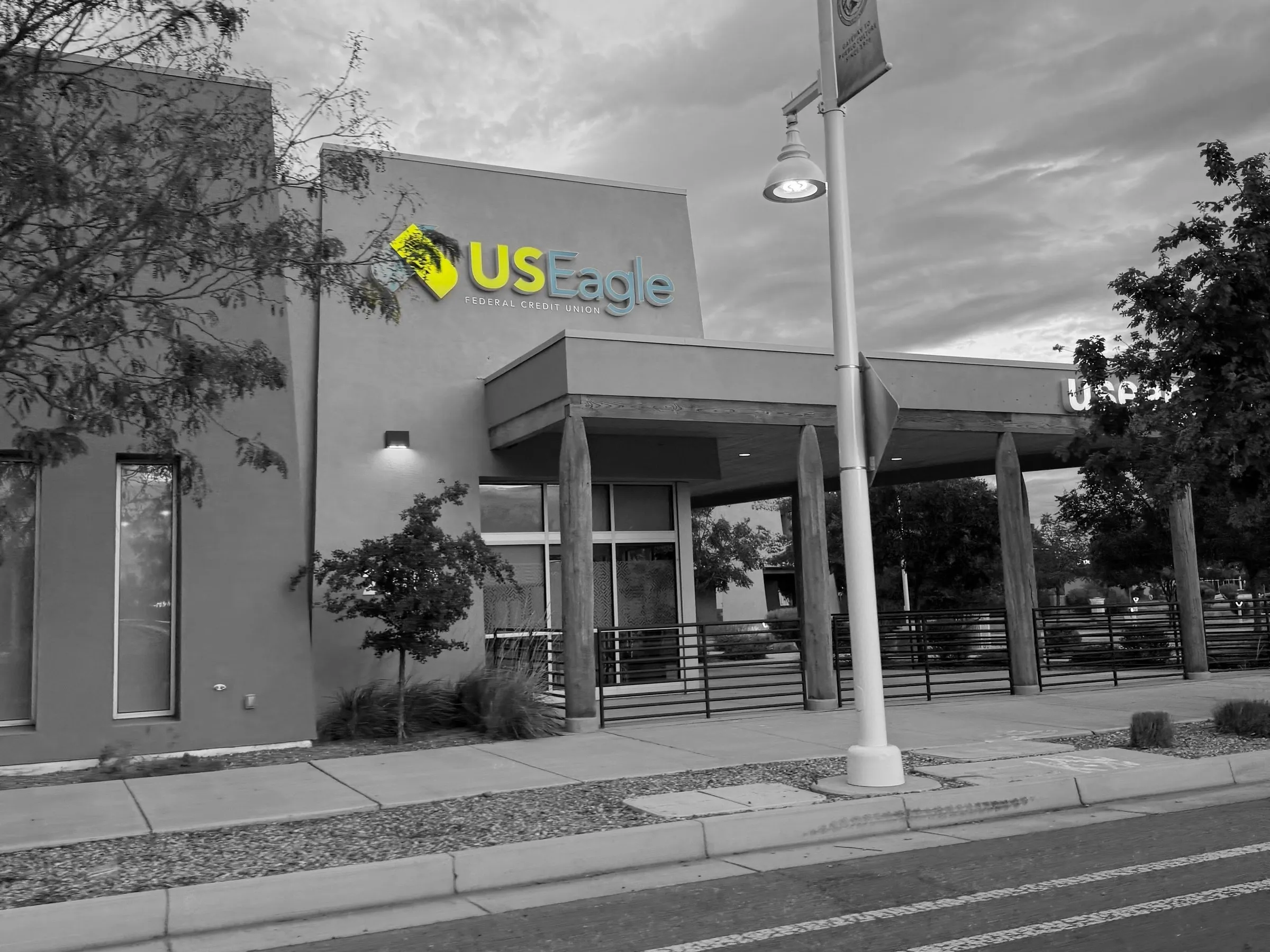
Have questions about this? Take them to U.S. Eagle's executives and board, not the tellers, loan officers or the people answering the phones. If you do call, be nice: the employees are probably just as mad as you. These loan policies weren't their decisions.
If you work or bank at U.S. Eagle, you may have been reading about it and wondering what it means for you. This is our attempt to answer that as plainly as we can, along with what it means for members and taxpayers. It goes with part one of our reporting and the Texas bank’s lawsuit.
If you’re a member
Your money is safe. Deposits at U.S. Eagle are insured by the federal government up to $250,000, no matter how the credit union is doing. When Greater Nevada Credit Union merged this month, its members’ insurance never lapsed.
If you pay federal taxes
The government guaranteed most of these loans, so taxpayers are on the hook when they fail. Right now, about $118 million of U.S. Eagle’s late USDA loans is guaranteed. That’s a snapshot from October, not a bill. Some loans may catch up, and the government gets some money back by selling what backed the ones that don’t.
If you’ve seen something wrong
These are the standard places to report a problem at any credit union or with a federal loan. They are not a sign we have evidence of wrongdoing at U.S. Eagle.
The law protects you for speaking up.
Federal law says a credit union can't fire you or retaliate against you for telling NCUA or the Attorney General about a possible violation of the law. It doesn't cover someone who knowingly took part in the wrongdoing or knowingly reported something false. If you're punished anyway, you have two years to take it to federal court.
Resources for employees
If a merger comes
NCUA's "Truth in Mergers" guide
NCUA's guide for credit union boards on how mergers work. Its advice on writing staff promises into the deal is on page 23.
If you lose your job
New Mexico Department of Workforce Solutions
Unemployment benefits, and free job-search help at Workforce Connection centers around the state.
If you work at U.S. Eagle
If you’re worried about your job, that makes sense. U.S. Eagle lost $30 million last year and another $10 million through June. Greater Nevada Credit Union, which made the same kind of loans, was merged into a Utah credit union on Oct. 1.
None of that is on the people at the branches or on the phones. These were business loans to companies in other states, not anything that crossed a teller’s counter.
Some reassurance: big credit unions almost never just close. Since 2008, we found only three credit unions with $1 billion or more that NCUA had to take over. One, Texans Credit Union, got back on its feet and was handed back to its members. The other two, Eastern Financial Florida and Melrose in New York, were run by NCUA until it handed their members and deposits to bigger credit unions. Far more often, a struggling credit union’s own board finds a partner and merges long before the regulator has to step in.
Nothing public says a merger is coming to U.S. Eagle, and NCUA, the federal regulator, hasn’t taken any public action against it. But if one does come, here’s what the last few years tell us.
You’ll probably hear that everyone keeps their job. That’s what Greater Nevada’s staff heard: the credit union that took it over said members would keep seeing the same team members at their local branches.
The executives’ deals are in writing. Yours don’t have to be. When a credit union merges, members are told by name and dollar amount what its top five employees and its board will get. Nobody has to put anything in writing for the tellers, the loan officers or the back office. And once the merger closes, the credit union that made you the promise doesn’t exist anymore, so there may be no one left to hold the new owner to it unless the agreement gives employees that right. NCUA, the regulator, recommends putting employees’ job security in writing: if staff are promised jobs, the merger agreement should say so, with no one let go in the first year without a real reason, like misconduct. We couldn’t find an example of a merger that did. The agreements themselves usually aren’t made public.
Jobs can disappear before a merger. From December 2024 to June 2026, while it struggled and before it merged, Greater Nevada went from 334 full-time employees to 287. Over the same stretch, U.S. Eagle went from 314 to 306.
- Greater Nevada
- U.S. Eagle
Quarterly, December 2024 to June 2026. Greater Nevada merged into America First on Oct. 1, 2026. Source: NCUA call reports (Form 5300, line 564A), published at /data/us-eagle/greater-nevada-staff.csv and /data/us-eagle/ncua-808-call-report-figures.csv.
Show the numbers
| Period | Greater Nevada | U.S. Eagle |
|---|---|---|
| Dec. 2024 | 334 | 314 |
| 317 | 310 | |
| 306 | 310 | |
| 301 | 311 | |
| Dec. 2025 | 298 | 309 |
| 298 | 312 | |
| June 2026 | 287 | 306 |
And after. We found ten mergers of struggling credit unions with at least 20 employees from 2019 to 2024. In seven, the merged credit union now has fewer people working there than the credit unions had together at the end of the year before they merged. Three have more.
Each chart runs from the end of 2019 to June 2026. The open dot is the number of employees at the end of the year before the merger, the dotted line is the merger, and the solid dot is the number in June 2026.
Creighton* into Cobalt, merged 2024
−20%
Vocality Community into Community First, merged 2024
−15%
RelyOn* into Neighborhood, merged 2024
−13%
Ball State* into Financial Center First, merged 2020
−10%
Central Coast into Wescom, merged 2023
−6%
Cooperative Center* into NuVision, merged 2023
−3%
Aspire* into Pentagon, merged 2021
−3%
Multipli* into River Region, merged 2024
+2%
Solano First* into Valley Strong, merged 2021
+8%
Peoples Choice* into Royal, merged 2021
+34%
* The buyer also took in at least one other credit union from 2020 on. Their employees are counted with the buyer's for the whole period. All ten 2019 to 2024 mergers NCUA coded "poor financial condition" or "poor management" where the credit union merged away had at least 20 employees. Employees are full- and part-time, counted as if the buyer and every credit union it took in from 2020 on had always been one. Two buyers' reports start a little after 2019; River Region's start in late 2023. This counts jobs, not who kept theirs. Source: NCUA call reports and merger reports, published at /data/us-eagle/weak-merger-staff-two-years.csv.
None of this means it will happen at U.S. Eagle. But you deserve to know what the record shows.
We didn’t contact any current or former U.S. Eagle employee for this story. Everything here comes from court records, government data and the credit union’s own filings.
Updated Oct. 14, 2026: We revised this story to source its facts to public records where we could, and removed details and quotes we could not confirm from a record.
Reader comments
What do you think?
Burqueños know this city best. Add what you've seen, ask a question, or push back on the story.
Loading comments…
New here? Sign up with your email. Confirm it and you're in, no password.
Comments are closed on this story.
Comments are the commenter's own words, not the Ledger's. Comment rules