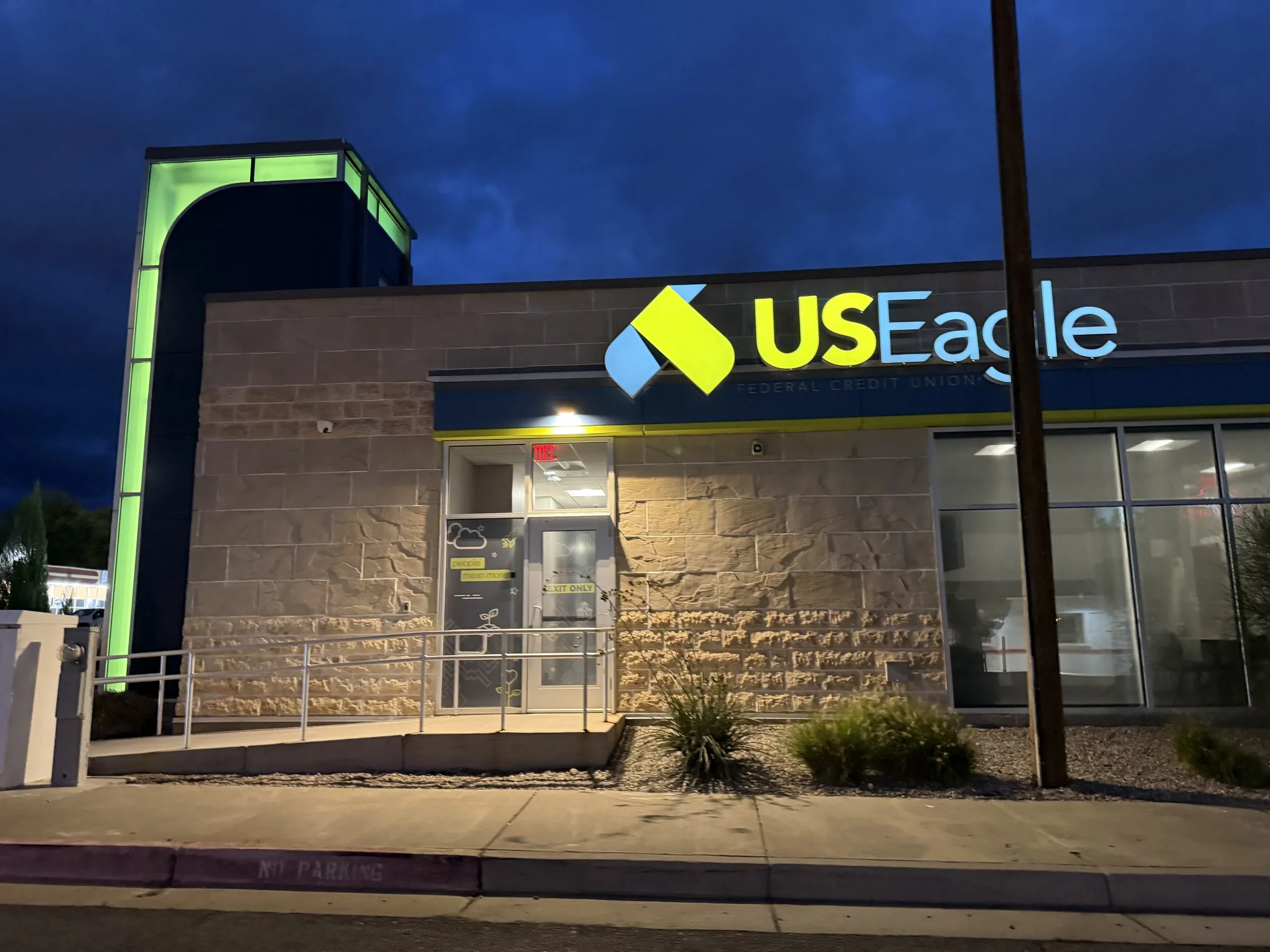
In May, a man who has run small businesses in New Mexico for twenty years stood up at U.S. Eagle Federal Credit Union’s annual meeting. Everyone could see interest rates were headed up, he said. How had the credit union missed that before making hundreds of millions of dollars in business loans?
Michael Moore, who had served the credit union for more than sixteen years, most recently as its chief financial officer, before being promoted to president and chief executive, answered:
Looking back, Monday morning quarterbacking ourselves a little bit, we probably shouldn’t have done those, and so we’re dealing with that right now.
Michael Moore, chief executive, at the annual meeting
Between 2019 and 2024 U.S. Eagle lent $416 million in business loans backed by the federal government, counting only the loans still open. About 91 percent of it went to businesses in fifteen other states, and $165 million of it is more than three months behind. In May the USDA revoked U.S. Eagle’s standing as an approved lender in the program. The credit union has stopped making business loans. In January, Marsha Majors, who had worked at the credit union for 40 years, retired, and Moore was promoted to president and chief executive at the same time.
- New Mexico
- Other states
- More than 3 months behind
The 42 loans still open. Every dollar more than three months behind is owed by a business outside New Mexico. Source: USDA Lender Lens loan-level data, September 2026 pull.
Show the numbers
| The loans | New Mexico | Other states | More than 3 months behind | Total |
|---|---|---|---|---|
| Lent, 2019 to 2024 | $38.9M | $377.2M | $0.0M | $416.1M |
| Still owed today | $36.4M | $166.5M | $165.1M | $368.0M |
Deposits are insured up to $250,000, and in its March report to regulators, about 96 percent of the money members kept at U.S. Eagle was under that limit. The losses don’t touch that insurance. They eat into the profits a credit union would otherwise return to its members through better rates and lower fees.
Is my money OK? How credit union savings are insured46 sec
Banknotes and the Capitol: public domain, via Wikimedia Commons. The Sandias at sunset: Brandon Stephenson, CC0. Fire footage: Pexels. Made with AI tools, including an AI voice and AI-drawn art.
Read it instead
No credit union member has ever lost a penny of insured savings. Here's why. Start with your savings, in a jar on the kitchen counter. Safe enough, until it isn't. So you take it to a credit union, where a fire or break-in at home can't touch it. But it doesn't just hold your money. It lends it out to neighbors, for cars, businesses and homes. To protect your money, every federally insured credit union puts money into a shared fund, run by the NCUA and backed by the United States. If a credit union ever fails, this fund covers each member for at least $250,000, automatically. The credit union in our story? Insured since 1971.
How the loans worked
The loans came through a USDA program meant to help rural businesses borrow. A lender puts up the money, and if the borrower stops paying, the government covers up to 90 percent of the loss. U.S. Eagle’s loans were backed at 70 to 90 percent.
The guarantee has limits. Under the program’s rules, USDA can refuse to pay when a loss comes from:
- careless lending, or careless handling of the loan afterward
- a lender that failed to secure the property backing the loan
- money spent on something USDA did not approve
- fraud or false statements the lender knew about
These are the program’s rules for every lender. No record we found says which, if any, applies to U.S. Eagle’s losses.
Even when it pays, USDA leaves out late fees and the extra interest charged once a borrower falls behind.
Where the money went
USDA’s records list 42 of U.S. Eagle’s loans. Four of them, worth $38.9 million, went to New Mexico businesses, including a small hospital in Farmington and a Hampton Inn in Carlsbad. None of the four is more than three months behind. The rest of the money went out of state.
Then interest rates rose. Loans in the program can carry a variable rate, one tied to the prime rate, which went from 3.25 percent at the start of 2022 to 8.5 percent by August 2023. For a borrower with a variable rate, the monthly payment climbed with it.
Since May, the amount more than three months behind has grown from $122.5 million to $165.1 million. Almost all of that increase is two sand mines that stopped paying, American Silica in Arkansas and Pontotoc Sands in Oklahoma.
- up to $11.8M
- $11.8M to $23.6M
- $23.6M to $35.3M
- $35.3M to $47.1M
- none
Amount more than 90 days delinquent on U.S. Eagle's OneRD loans, by the state the loan was made in, each rounded to the nearest $100,000, which is why they sum to $165.0 million against the $165.1 million total. No loan in New Mexico, Texas, Georgia, Utah, Hawaii, Pennsylvania, Wisconsin, Wyoming or California is more than 90 days behind. Source: USDA Lender Lens loan-level data, September 2026 pull.
Show the numbers
| State | More than 3 months behind |
|---|---|
| Colorado | $47.1M |
| South Carolina | $27.9M |
| Oklahoma | $27.8M |
| Ohio | $21.5M |
| North Carolina | $19.5M |
| Arkansas | $18.6M |
| Arizona | $2.6M |
U.S. Eagle was one of ten lenders whose approval USDA revoked in May, out of more than 760 in the program. Together the ten held about $620 million in loans that had fallen behind, close to half of all the late loans at the USDA agency that runs the program.
The biggest loan, 500 miles away
The biggest problem is a youth sports and stadium project in Windsor, Colorado, about 500 miles from Albuquerque. U.S. Eagle made three loans to it totaling $48.6 million, and $37.7 million of that is more than a year behind. In August the credit union told a federal bankruptcy court it was owed at least $61 million on the project, counting interest, fees and nearly $5 million of its own legal bills. The developer’s companies had filed for bankruptcy in July, and a judge threw out the first of those cases on September 1.
How much the government will pay on these loans is not settled, and those claims are decided by the same agency that revoked U.S. Eagle’s approval.
The losses
How U.S. Eagle compares with the state’s two largest credit unions, from what each reported to regulators:
Net income (loss) by year. As reported to the National Credit Union Administration; 2026 covers January to June.
| Credit union | 2023 | 2024 | 2025 | Jan to Jun 2026 |
|---|---|---|---|---|
| Nusenda | +$24.2M | +$28.1M | +$21.3M | +$19.2M |
| Sunward | +$4.1M | +$6.2M | +$5.7M | +$8.5M |
| U.S. Eagle | +$2.7M | -$0.2M | -$30.2M | -$10.0M |
Since the start of 2024, U.S. Eagle has lost about $40 million by its reports to regulators, $10.0 million of it in the first half of this year.
A bank walked away
In August 2024, U.S. Eagle agreed to buy Southwest Capital Bank, which would have added six branches in New Mexico. The deal did not close. In September 2026, Southwest Capital Bank’s parent company agreed instead to combine with WestStar Bank, a Texas bank, in a deal expected to close in early 2027.
The cushion
Every credit union keeps money set aside to absorb losses. Regulators measure it as a share of everything the credit union owns and consider 7 percent or more healthy. A credit union that drops below that has to rebuild the cushion a little every quarter until it is back above 7 percent.
- Net worth ratio, from quarterly filings with NCUA
- Weiss Ratings' estimate, Aug 2026
The net worth ratio is account 998 on the quarterly call report, the measure that decides the classification. Charter 808. Five of these quarters, December 2023, December 2024, December 2025, March 2026 and June 2026, are archived at research/data/us-eagle-usda-lending-losses/ with the script that pulls them; the other nine come from the same quarterly series. Weiss's August figure is its own net capital ratio, built from the same filings, and is shown as a separate point. Sources: NCUA call reports, Weiss Ratings.
Show the numbers
| Quarter | Net worth ratio, from quarterly filings with NCUA |
|---|---|
| Mar 23 | 10.62% |
| Jun 23 | 10.93% |
| Sep 23 | 11.11% |
| Dec 23 | 10.86% |
| Mar 24 | 10.59% |
| Jun 24 | 10.56% |
| Sep 24 | 10.71% |
| Dec 24 | 10.62% |
| Mar 25 | 10.16% |
| Jun 25 | 9.09% |
| Sep 25 | 9.25% |
| Dec 25 | 8.53% |
| Mar 26 | 8.11% |
| Jun 26 | 7.80% |
| Aug 26 (Weiss Ratings' estimate, Aug 2026) | 6.86% |
U.S. Eagle’s cushion was 8.53 percent at the end of 2025, 8.11 percent in March and 7.80 percent in June. That leaves it less than a point above the 7 percent line.
Weiss Ratings, a company that grades banks and credit unions from the same reports, gave U.S. Eagle a D in August, which on its scale means weak financials.
Weiss gives Nusenda a B. Sunward, the other credit union in the table above, also gets a D.
For members
A credit union has no shareholders. The money it sets aside comes from profits it kept instead of returning to members, and the losses came out of that money. The same money protects members’ accounts if things get worse.
Deposits up to $250,000 are insured. Anyone with more than that at U.S. Eagle should check how the limit applies, because it is counted by type of ownership, such as individual, joint and retirement accounts, not account by account.
U.S. Eagle did not respond to the Ledger’s request for comment before this story was published. It has not said why its longtime chief executive left or whether it expects the government to cover the loans that stopped paying.
After this story ran, U.S. Eagle sent a statement, attributed to Moore, saying many of its facts are “incorrect, hyperbolized or misleading.” It did not say which. Read U.S. Eagle’s statement in full.
Who approved $48.6 million in loans to a youth sports complex 500 miles away? Part two follows the loans back to the people who made them.
Updated Oct. 5 to add U.S. Eagle’s statement.
Updated Oct. 14, 2026: We revised this story to source its facts to public records where we could, and removed details and quotes we could not confirm from a record. This update also corrected two details; see corrections.
Reader comments
What do you think?
Burqueños know this city best. Add what you've seen, ask a question, or push back on the story.
Loading comments…
New here? Sign up with your email. Confirm it and you're in, no password.
Comments are closed on this story.
Comments are the commenter's own words, not the Ledger's. Comment rules